
Weak or unavailable grid
Remote or regional sites where grid supply is weak, unavailable or impractical.
A Nusfun Solution Platform
Integrated energy. Wherever power is needed.
Project-specific distributed energy architectures integrating solar PV, battery energy storage, PCS / hybrid inverters, gensets, grid connection and intelligent energy management.
Start with the operating problem, not a product catalogue.
Remote or regional sites where grid supply is weak, unavailable or impractical.
Operations seeking to reduce generator runtime and improve energy efficiency.
Sites where existing energy infrastructure no longer matches operational demand.
Facilities where power interruptions create material operational risk.
Sites seeking better coordination between solar, storage, generation and loads.
Solar PV + BESS + PCS / hybrid inverter + genset + grid + distribution + EMS + loads.
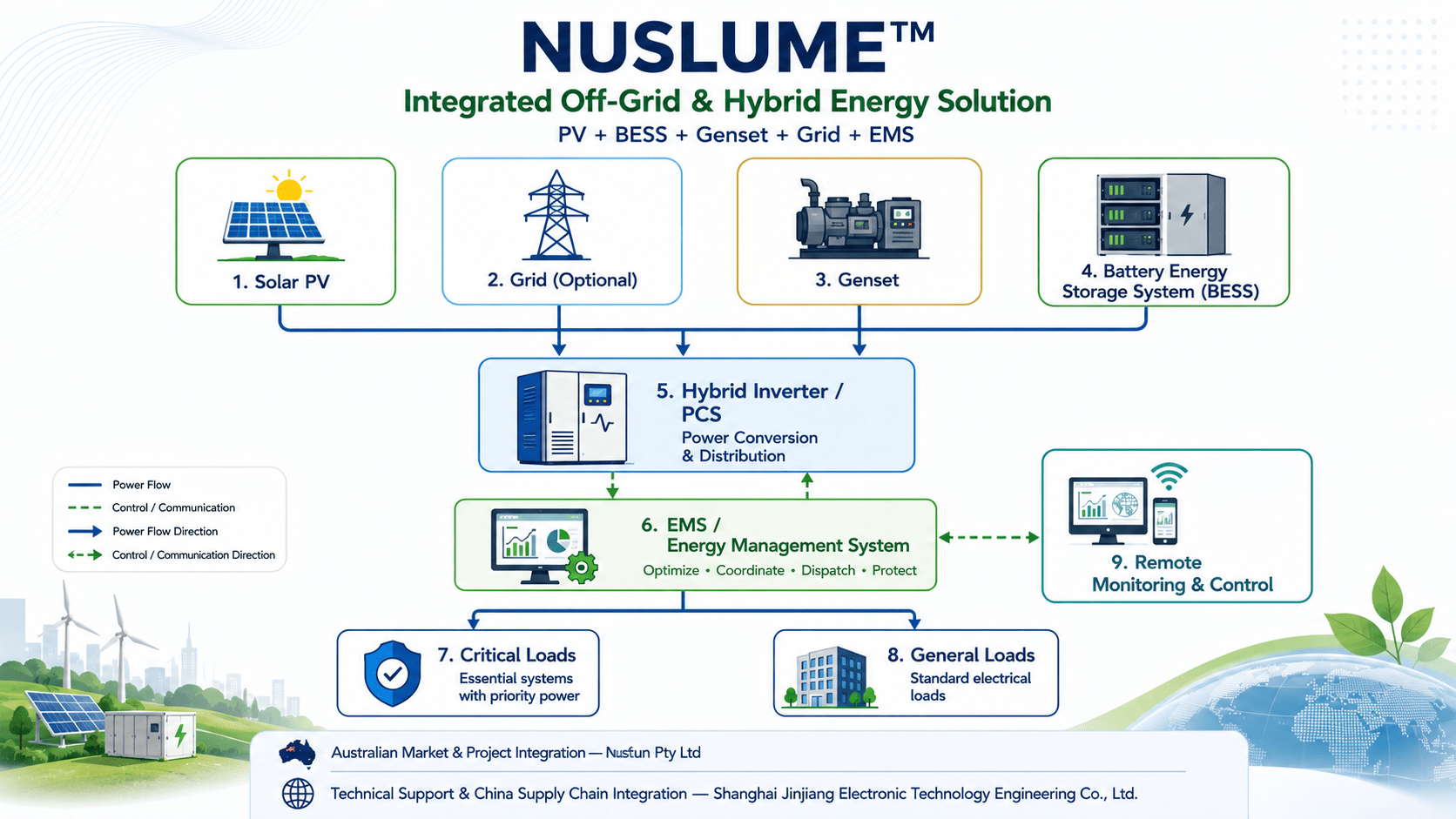
Conceptual system architecture. Final topology, protection, switching, equipment selection and compliance requirements are subject to project-specific engineering assessment.
The EMS coordinates and controls operation. Primary electrical power flows through the power conversion and distribution architecture.
Equipment is selected as part of the overall project architecture rather than from a fixed catalogue.
Renewable generation sized and configured around the site load profile and operating objective.
LV, HV and C&I BESS options assessed for usable energy, power, lifecycle and operating environment.
Bidirectional conversion, AC- or DC-coupled architectures, grid-forming / grid-following functions and source coordination where required.
Firming and backup generation coordinated to reduce runtime while maintaining resilience.
SOC management, dispatch priorities, schedules, alarms, monitoring and project-defined operating logic.
Switchboards, metering, protection, load segmentation and project-specific interface requirements.
Six solution pathways, each configured project by project.
Project-specific power architectures for sites without practical grid supply.
Coordinated PV, BESS, genset and optional grid resources under defined operating logic.
Grid-connected or behind-the-meter architectures combining generation, storage, controls and site loads.
Storage integrated into the wider site architecture for shifting, reserve and resilience.
SAPS concepts developed around site demand, autonomy and applicable Australian requirements.
Critical-load prioritisation and coordinated backup sources for continuity of operation.
Priority sectors for project assessment and partner engagement.
Remote operations, processing facilities, camps and supporting infrastructure.
Solar pumping, irrigation, sheds, poultry, cold rooms, processing loads and remote farm infrastructure.
Factories, warehouses and commercial sites requiring hybrid resilience or peak management.
Facilities and infrastructure where grid access is limited, weak or delayed.
Technology selection follows the site, load profile and operating requirement.
Confirm objectives, location, existing supply and project constraints.
Review interval data, peak demand, critical loads, start-up loads and future growth.
Define sources, storage, conversion, distribution, operating modes and resilience strategy.
Assess equipment categories and suppliers against technical, commercial and compliance needs.
Coordinate interfaces, protection, documentation and project-specific regulatory requirements.
Coordinate selected equipment, controls, responsibilities and delivery scope.
Support local delivery, commissioning coordination, performance review and lifecycle planning, subject to scope.
Nusfun Pty Ltd leads Australian market development, customer engagement, commercial coordination, project integration and local delivery. Shanghai Jinjiang Electronic Technology Engineering Co., Ltd. provides technical support and coordinates China-side engineering and supply-chain resources.
NUSLUME™ is operated by Nusfun Pty Ltd. Project-specific design, installation, certification and responsibility scopes are confirmed for each engagement.
Formal platform documents currently available for customers and partners.
Platform scope, capabilities and engagement model.
Solution positioning, operating modes, engineering approach and partner model.
Reference architecture and design principles.
Tell us what needs to be powered, where the site is located and what operating constraints must be considered.